
History
~ 1750: The Katerloch was probably known even earlier than the nearby Grasslhöhle cave, which was discovered around 1750 after a tree had broken open its entrance, and first mentioned in 1816. By comparison, the entrance of the Katerloch (20m wide, 10m high, see the photo on the home page) was much larger and easy to see from outside.
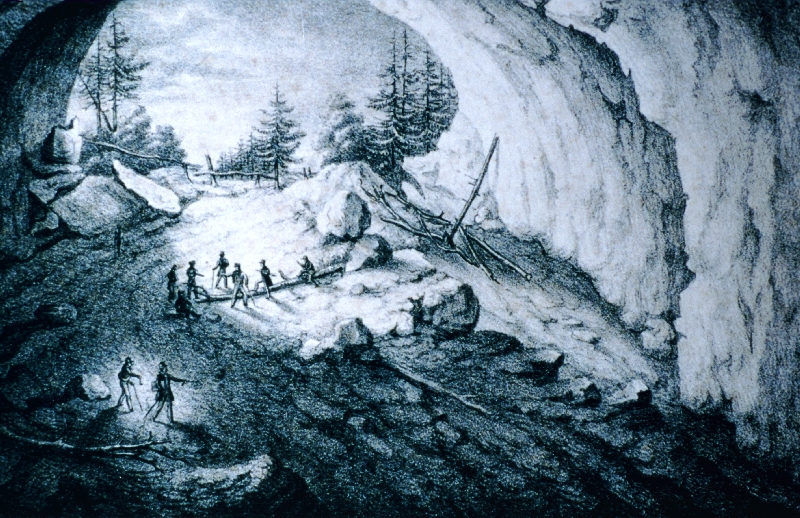 1837: The oldest picture of the Katerloch was made by August Mandel in 1837. Mandel also wrote the first published reference to the cave. Even then, people tried to light up the great shaft (the Owl Shaft, Eulenschacht) with burning tree trunks, without success. An even earlier mention of the shaft, or even a descent into it, by a geologist named Martel from Graz around 1826 has not yet been proven; it may even be a mix-up with August Mandel.
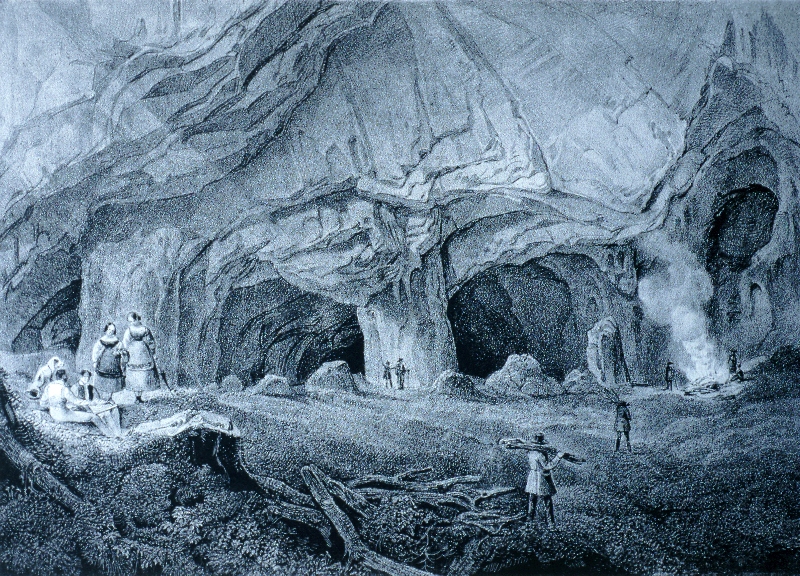 1841: The next picture is an engraving by Josef Kuwasseg from 1841; an enlargement of it hangs on the wall of the ticket office.
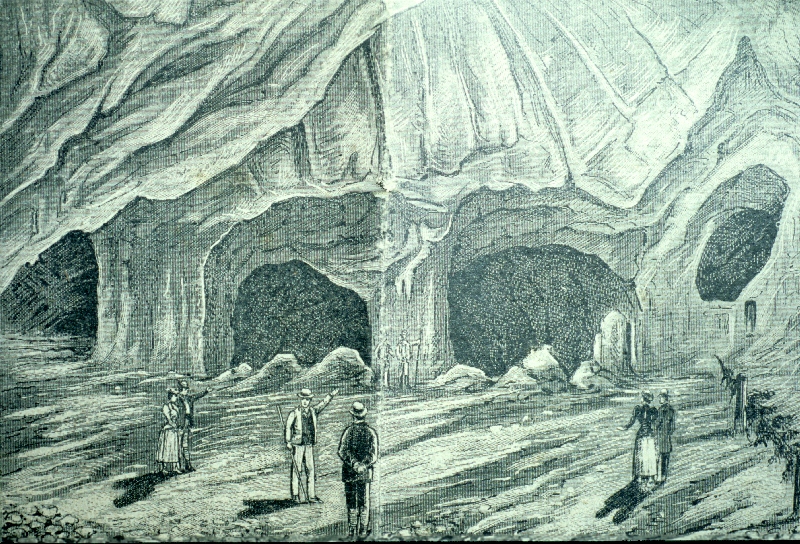 1893: The next view of the Katerloch, based on Kuwasseg's, appeared in “Das interessante Blatt 1893” , an old newspaper.
1899: In 1899 Adolf Mayer made the first documented descent into the Great Shaft. There was another descent in 1906.
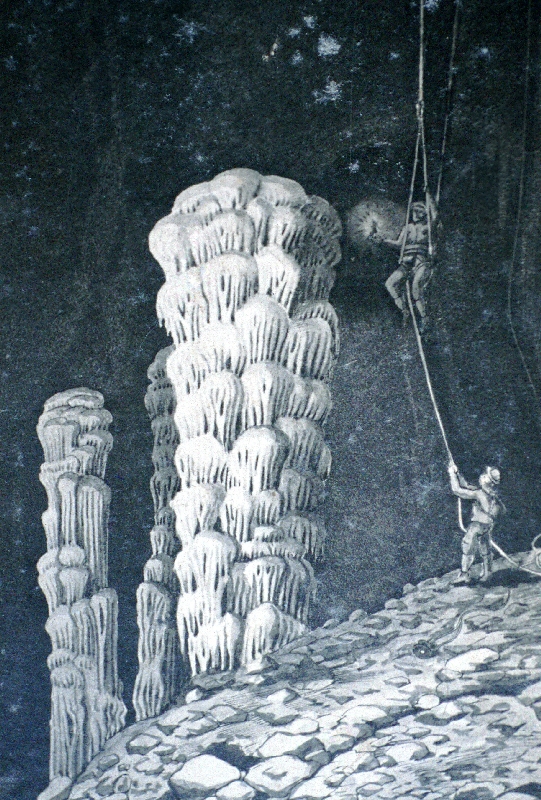
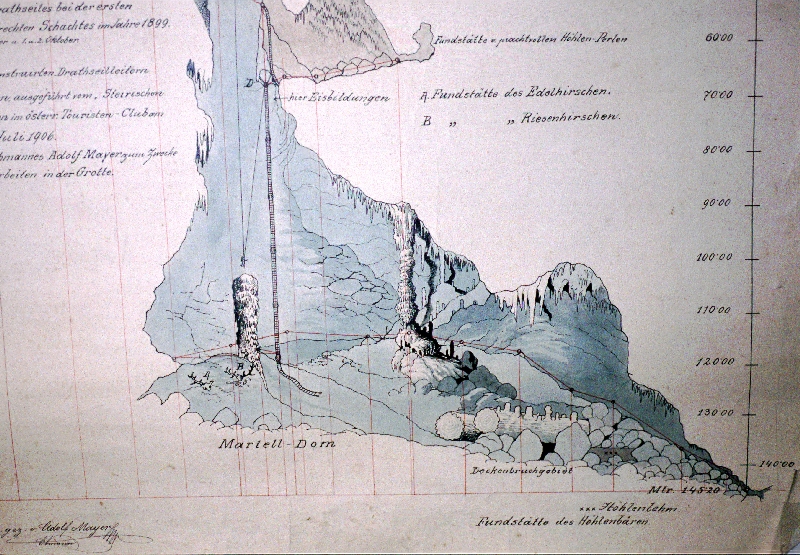
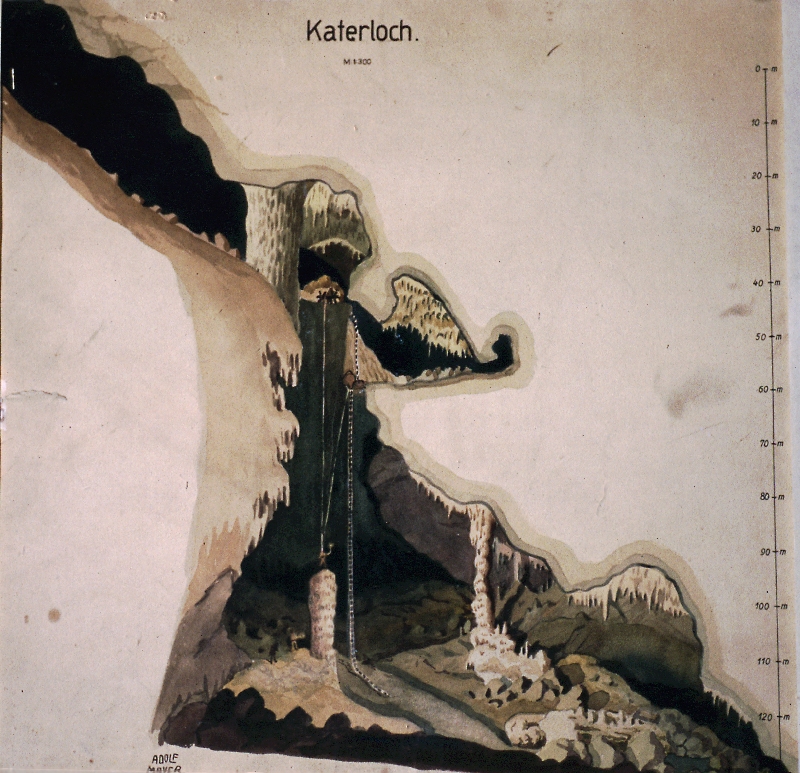
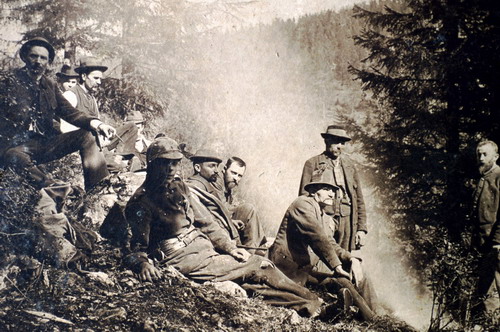
1908: Hermann Bock explored the cave in 1908 and drew what was probably the first plan of the Katerloch, apart from Adolf Mayer's detailed drawings and watercolours.
1923: After that, nothing of note happened for almost 1 1/2 decades; the First World War prevented further exploration. After the war, in the early 1920s, Otto Kropatsch came to Weiz to find work at the ELIN company. He founded the Weiz caving club (Verein für Höhlenkunde Weiz) and led its members on several trips into the cave, during which some new side sections of the “Martel Dome” were discovered.
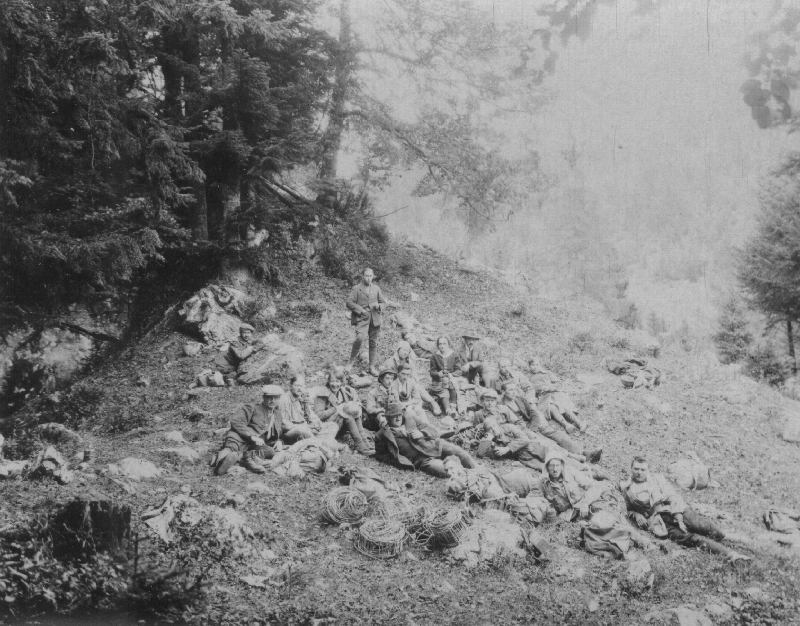
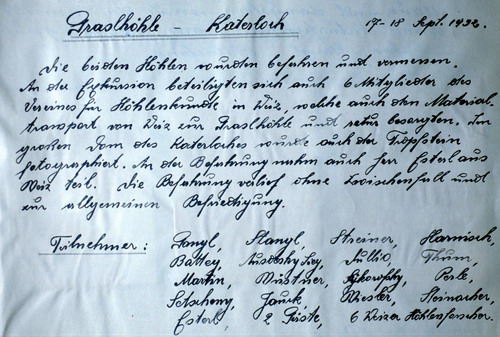
1932: On 17 and 18 Sept. 1932 the Styrian caving association (Landesverein für Höhlenkunde in Steiermark) surveyed the Katerloch together with 6 cavers from Weiz, and a new plan was drawn. There is no mention of it in the Weiz cavers' logbook. The Second World War again brought all exploration to a halt.
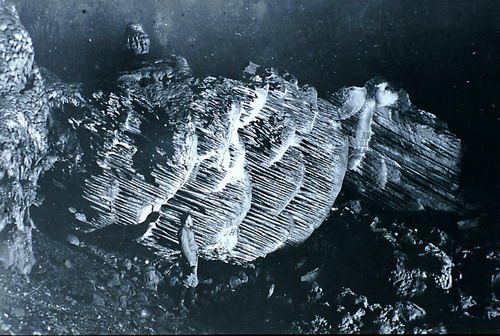
1950: Hermann and Regina Hofer come to the Dürntal on an extended honeymoon and first devote themselves to the Grasslhöhle cave. They renew its paths and stairs, install the first electric lighting there and, in painstaking detailed work, clean the soot left by the pitch torches of past decades from many dripstone formations. The explorer couple lease both caves, the Grasslhöhle and the Katerloch. In July 1952 the Grasslhöhle is ceremonially opened to the public. With the tours of the Grasslhöhle the couple finance their research in the much larger Katerloch, which is also far more interesting to them as explorers.
From 1951: Descending the Owl Shaft, more than 70m deep, Hermann and Regina Hofer first explore the “Martel Dome” of the Katerloch thoroughly on several occasions.
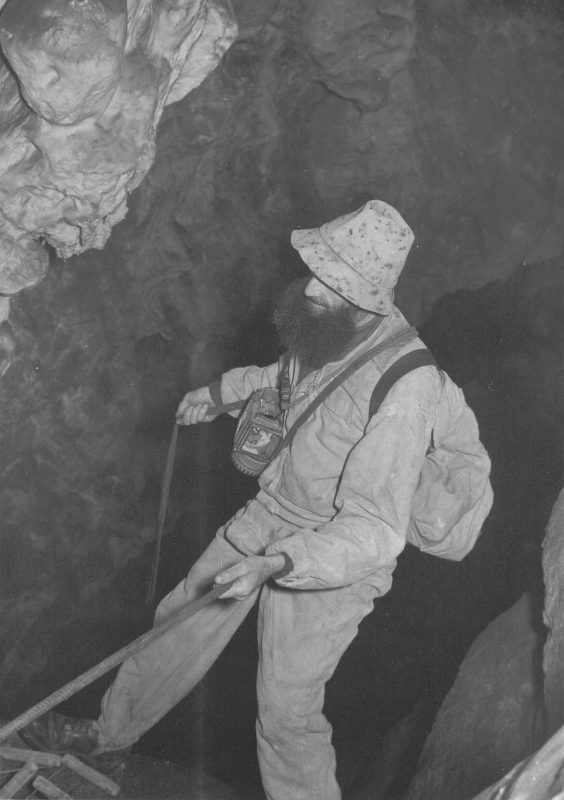 19.4.1952: In the presence of his wife and his companions Ganster and Ing. Stimpfl, Hermann Hofer becomes the first to climb a 13-metre, partly overhanging dripstone wall in order to investigate an opening spotted high up. Having scaled the wall, he finds himself, to his great delight, in the newly discovered “Hofer Hall” (Hoferhalle). This was one of the key points for discovering further systems of chambers: from examining draughty tubes close to the ceiling, the explorers concluded that there must be further passages beyond them. The research of the following 1 1/2 years leads to a unique series of successes.
3.5.1952: In the “Martel Dome”, Hermann and Regina Hofer climb up to the “Solomonic Gallery of Splendour” (Salomonische Prunkgalerie).
26.6.1952: By way of the “Sea Lion Pit” (Seelöwengrube), the “Penitents' Gallery” (Büßergalerie) and the “Penitents' Passage” (Büßergang), Hermann Hofer and his brother Konrad reach the “Hall of Solitude I” (Halle der Einsamkeit I).
16.7.1952: Having crossed the “Hall of Solitude II”, the explorer couple Hermann and Regina Hofer once again search for openings and draughty passages. After breaking through a sinter wall one metre thick, they achieve THE sensation: the discovery of the “Fantasy Hall”.
6.8.1952: Working steeply upwards towards the north, the explorers manage, among other things, to laboriously widen a 20cm opening until it is just big enough to crawl through, and so reach the “Viewing Hall”.
2.7.1953: After precise preparatory surveying, the breakthrough from the “Viewing Hall” to the “shaft ledge” (Schachtvorstufe) of the “Entrance Hall” is achieved. The arduous descent through the shaft is now a thing of the past, and tours for “ordinary” visitors become possible for the first time.
In 1953/54 the “Labyrinth” is explored as far as the “Turkish Tent” (Türkenzelt).
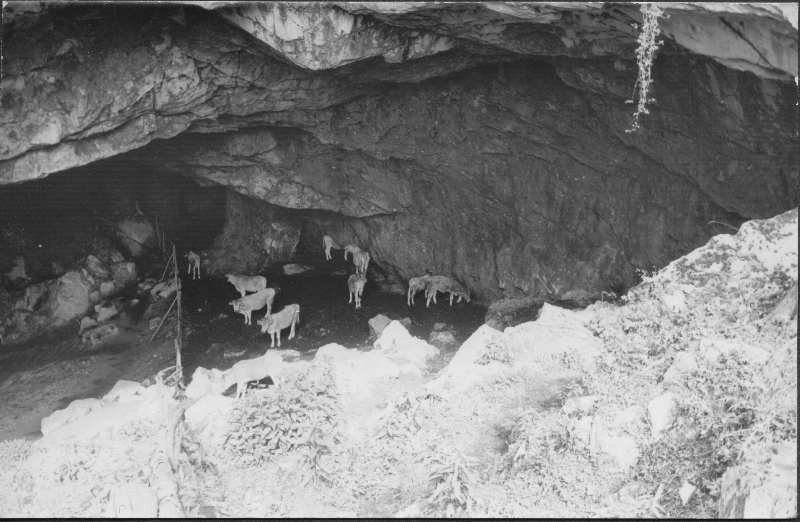 27.3.1954: The Federal Monuments Office (Bundesdenkmalamt) declares the Katerloch a NATURAL MONUMENT and places it under the protection of the Natural Caves Act. From then on the Katerloch may no longer be used as a shelter for livestock or as a cowshed.
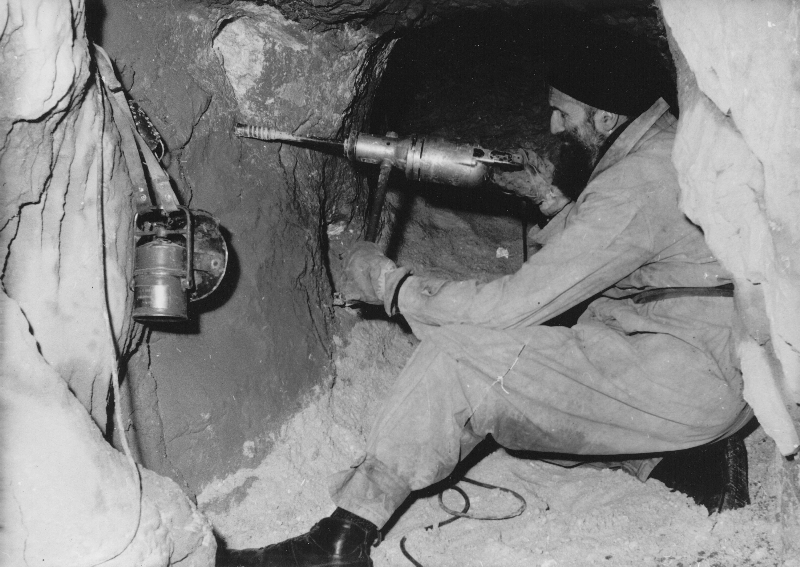 27.7.1955: Another sensation: after breaking 4 metres through a sinter wall, the explorers discover the “Magic Realm”, and only two days later an untouched water landscape, “Lake Paradise”. Opening up these two parts of the cave over the following two years by means of tunnels up to 11m long is another masterly achievement.
8.6.1958: Tours had already been held in the Katerloch on provisional paths; now the show cave is ceremonially opened, together with the access road.
Ladders are fitted and the first electric lighting is installed.
At the same time several zoologists are able to carry out research in the cave, with considerable success. Josef Vornatscher records a number of animal species in the cave.
Dr Kurt Bauer also makes the first (Holocene) record of the pond bat for Austria.
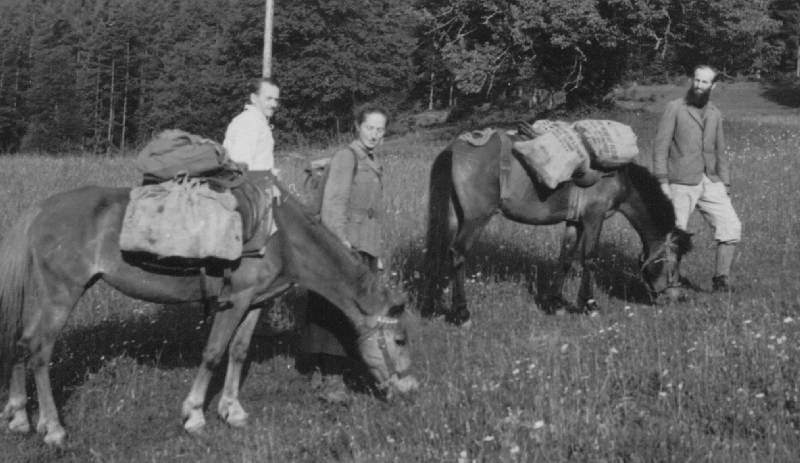
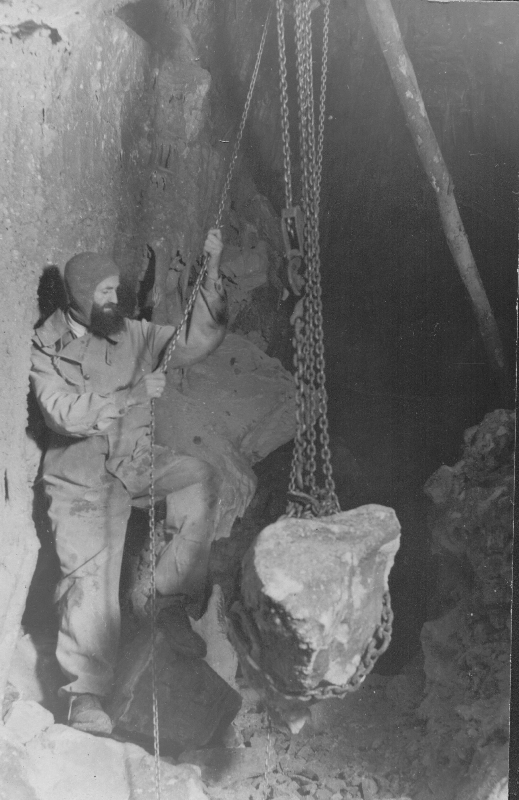
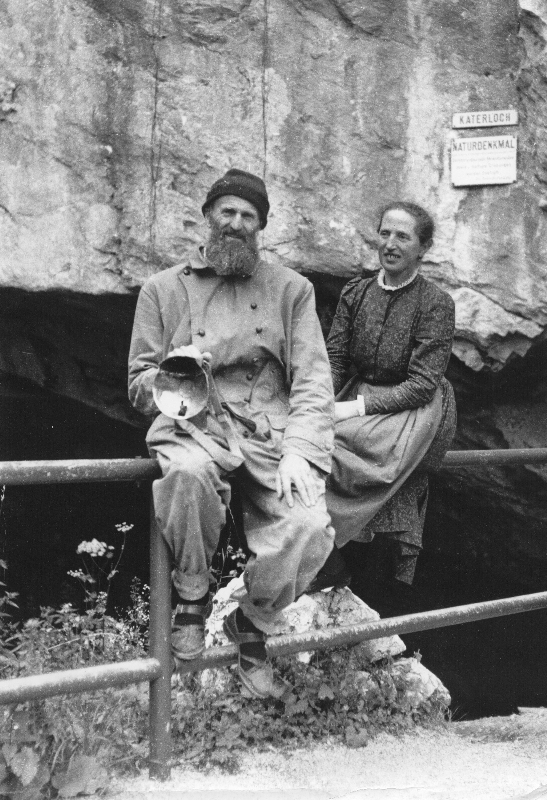
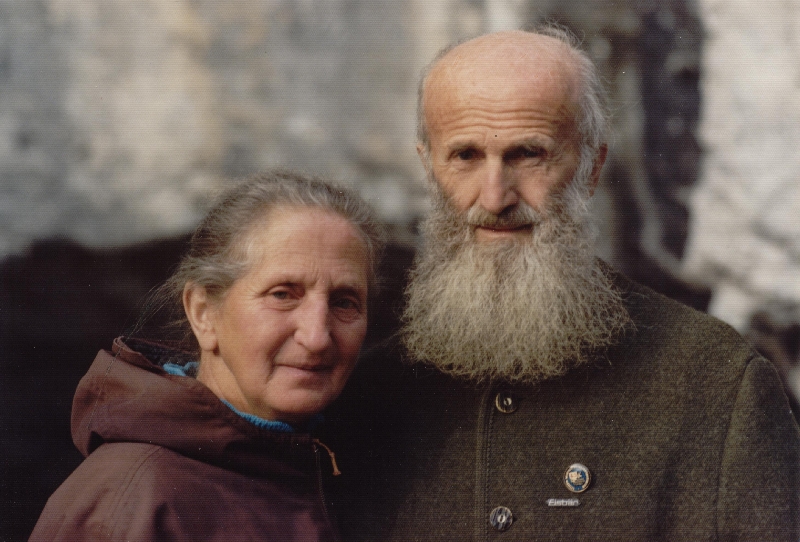 approx. 1984: After 30 years of tours, the two discoverers, by now over 70, stop regular tours of the show cave because of their age. From then on only special tours for small groups are possible. Mass tours, during which careless cave tourists sometimes did great damage to the Katerloch, are now a thing of the past.
4.12.1995: A legendary couple of explorers and discoverers is parted by the death of Regina Hofer at the age of 83. Hermann Hofer finds it hard to recover from this loss, but after a break he continues the special tours for a few more years.
1997-2003: Hermann Hofer, still sprightly in old age, devotes himself to training his “cave explorer's apprentice”, Mag. Fritz Geissler. For 7 years he introduces him to an enormously wide-ranging life's work and hands the Katerloch over to him during his lifetime: small groups are to be able to marvel at the explorer couple's great discoveries of 1952 to 1955 in the future too.
9.9.2003: Hermann Hofer, a pioneer of Austrian cave exploration, dies at the age of 95.
April 2004: After extensive renovation work (tour path/ iron stairs, electrics, infrastructure), Mag. Fritz Geissler begins to continue the show cave tradition with tours for smaller groups.
REFERENCES (in German):
Die Grasel-Höhle und das Katerloch nächst Weitz in Steiermark. Steiermärkische Zeitschrift, NF, 4 (1), Grätz, 1837:137 – 151
BOCK Hermann, LAHNER Georg, GAUNERSDORFER Gustav (1913) - Höhlen im Dachstein und ihre Bedeutung für die Geologie, Karsthydrographie und die Theorien über die Entstehung des Höhleneises.- Vlg. Ver. F. Höhlenkde. I. Öst., Wien
STROUHAL, VORNATSCHER (1975) - Katalog der rezenten Höhlentiere Österreichs, Wiss. Beih. Zur Zeitschrift „Die Höhle“, 24, Seite 518, 519, Wien, Dez. 1975
BAUER, Kurt (1987) - Die holozäne Fledermausfauna des Katerloches bei Weiz, Steiermark (Mamm., Chiroptera). Mitt. Abt. Zool. Landesmus. Joanneum, Heft 40, Seiten 25-40, Graz 1987