
Geology
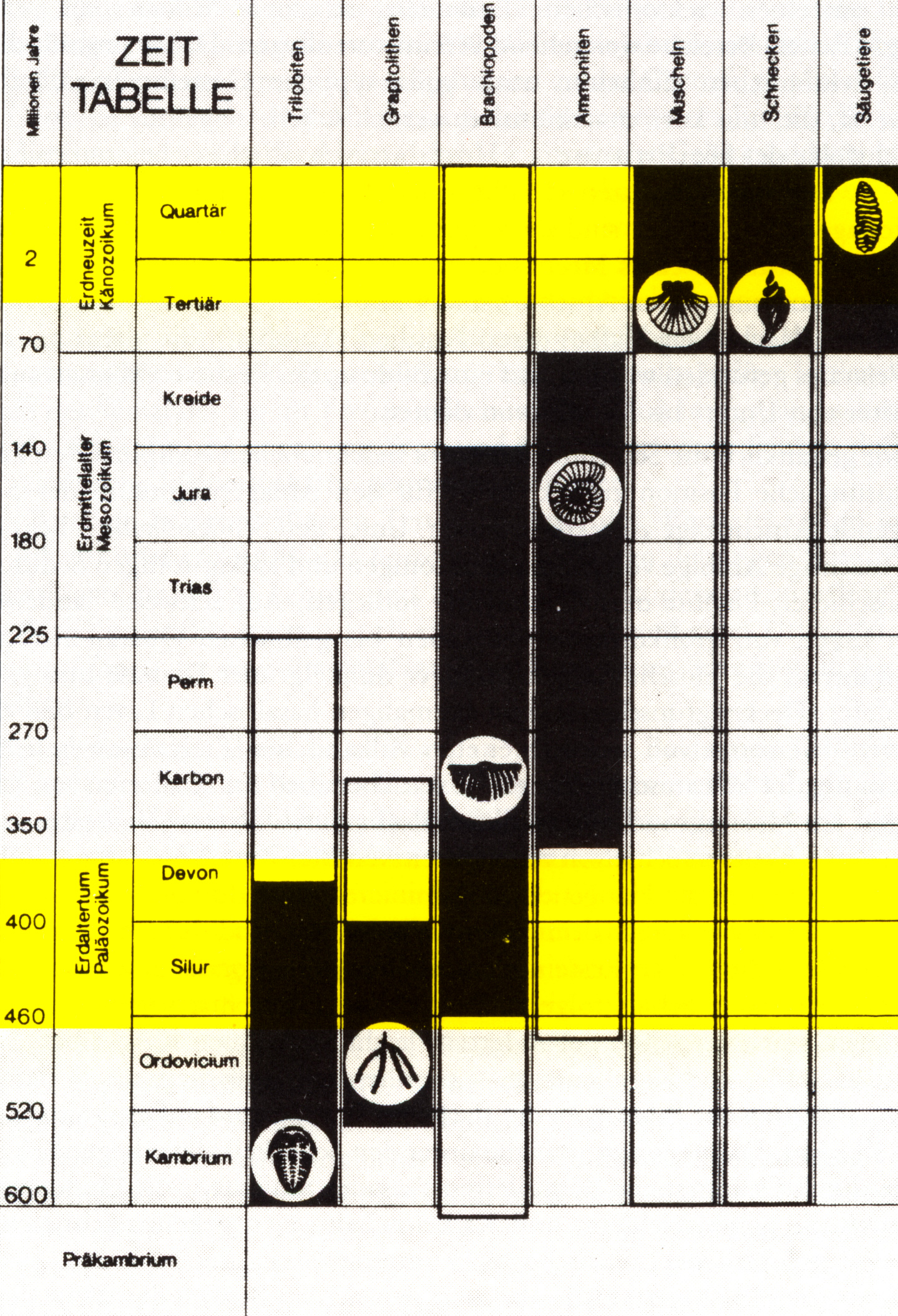 The Katerloch lies at 900 m above sea level in the so-called “Lärchsattel”, a saddle-like depression in the “Sattelberge” hills, which run north of Weiz between the Weizklamm and Raabklamm gorges as a distinct mountain ridge. This ridge forms the natural boundary with the Passail basin (Passailer Kessel) and consists mainly of Schöckel limestone (Schöckelkalk). This rock dates from the Palaeozoic (Devonian) and is therefore at least 350 million years old. Because of its purity it is highly susceptible to karstification, as shown by the numerous caves, sinkholes (dolines) and other karst features in the Raab and Weiz gorges.
Formed in a former sea, the Schöckel limestone shows pronounced bedding, with the associated system of discontinuities (bedding planes and joints). Folding lifted the once horizontal limestone beds, and great pressure subjected them to metamorphism, in which the last fossils disappeared from the rock and the limestone turned into a “crystalline limestone”, almost a marble.
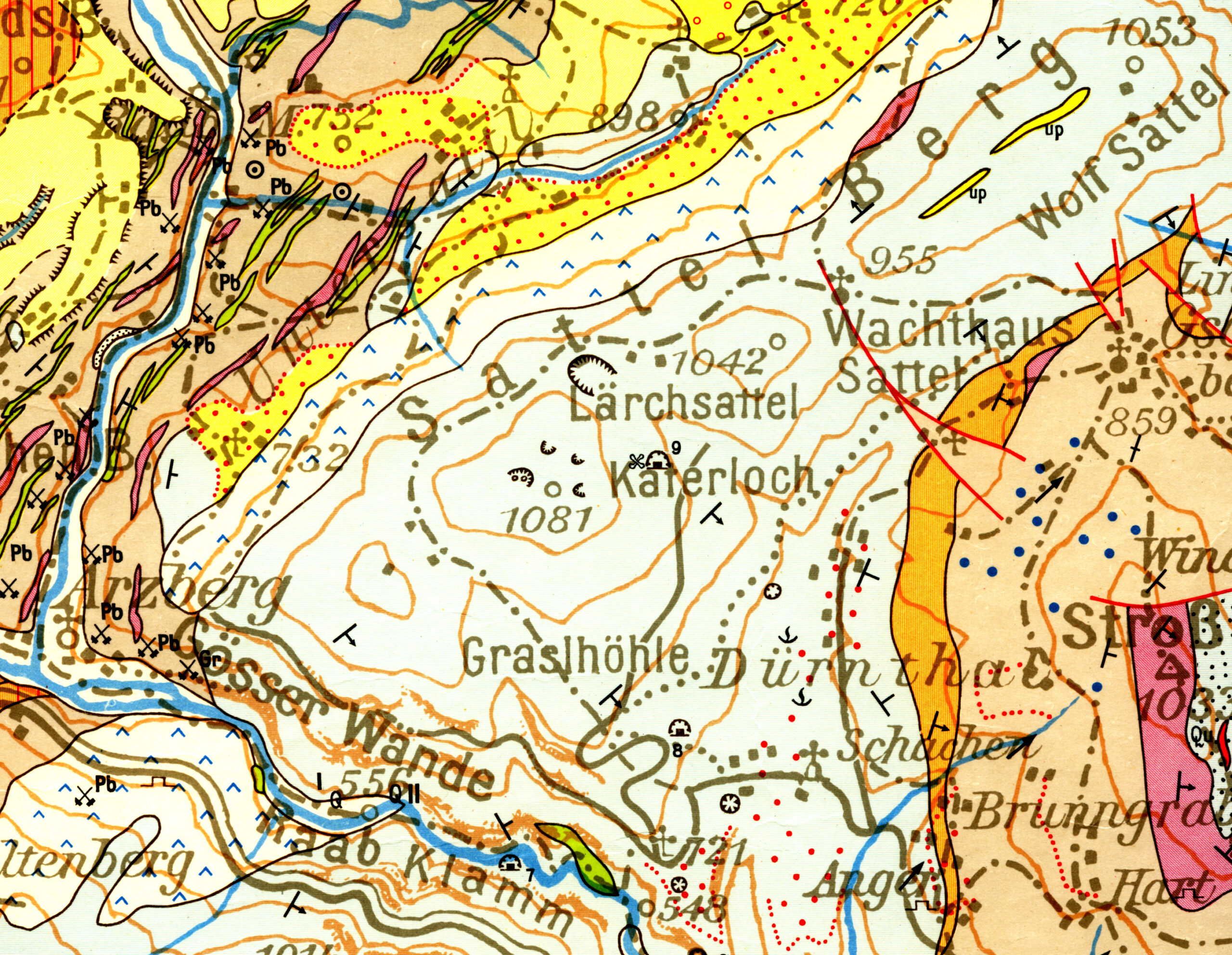 As it was uplifted and a mountain ridge formed, the Schöckel limestone reached the zone of the former groundwater level (today the Hochstradner level at around 700 m above sea level), where large caves could form in places (around 170 caves are known today in the area between the Weizklamm and Raabklamm gorges). It is assumed that the Passail basin partly drains underground through the Sattelberge towards the south. During this long process the two rivers, the Raab and the Weizbach, cut ever deeper into the rock, lowering the groundwater level as they did so.
Huge cave chambers were left dry and, without the counter-pressure of the water, could not remain stable. The caves collapsed, but the collapse in turn created new chambers. This can be seen impressively in the Fantasy Hall of the Katerloch. Here a chamber measuring 120 by 85 m has formed along a bedding plane that dips towards the south-east (SE) in this area. At the upper end of the hall you can see how the floor would fit seamlessly into the ceiling.
Once the chambers that can be visited today had formed, a fantastic, bizarre world of dripstones was able to develop thanks to the green karst (karst covered with soil and vegetation), and here too several phases of formation and destruction can be seen. The enormous growth of dripstones and repeated rockfalls subsequently divided the large halls into separate, smaller chambers. In places the walls of the Martel Dome consist only of collapsed blocks cemented together by sinter; large dripstones up to 3 m in diameter have toppled over several times in the course of time and lie in fragments at the bottom of the Martel Dome. One of these dripstones (Bismark) currently stands about 12 m high. The largest dripstone column in the Katerloch has a circumference of 46 m.
REFERENCES (in German):
EBNER, Fritz (1984) - Die Geologie des Weiztales, ein Abbild von 500 Millionen Jahren Erdgeschichte. In: EBNER, Fritz (1984): Naturführer Weiztal.-Veröffentlichungen der Forschungsstätte Raabklamm X, 5-12, Weiz.
FLÜGEL, Helmut & MAURIN, Viktor (1958) - Geologische Karte des Weizer Berglandes.- Geologische Bundesanstalt, Wien (Beilage zu FLÜGEL & MAURIN 1959).
FLÜGEL, Helmut & MAURIN, Viktor (1959) - Geologische Wanderungen im Weizer Bergland.- Weiz-Geschichte und Landschaft in Einzeldarstellungen, 6 , Weiz.
FLÜGEL, Helmut (1975) - Die Geologie des Grazer Berglandes.- Mitt. d. Abt. für Geologie, Paläontologie u. Bergbau am Landesmuseum Joanneum, Sh. 1, 2. Auflage, Graz.
FLÜGEL, Helmut (2000) - Das Paläozoikum von Graz (Stmk., Österr.): Kenntnisstand 2000. Sitzungsberichte Abt. I (1999) 206: 3-10.
FUCHS, Gerald (1983) - Der Karst am Ostufer der Weizklamm.- Berichte d. wasserwirtschaftl. Rahmenplanung, 65 , 1-50, Graz (Fortdruck in: Mitt. Landesver. f. Höhlenkunde i. d. Stmk. 12 (1), 1-50, Graz).
POLT, Harald (1995) - Die Höhlen am Westufer der Weizklamm.- Mitt. Landesver. f. Höhlenkunde i. d. Stmk., 24 (1-4), 6-167, Graz.
TRIMMEL, Hubert (2002) - Altersbestimmungen an Kalksintern aus Höhlen der Steiermark – Bisher kaum bekannte Ergebnisse von Radiokarbondaten. Die Höhle 53 (2), 37-50, Wien.