
Bats
In our latitudes bats are not permanent cave dwellers but only guests. In the Central Styrian uplands, or more precisely the Weiz uplands (Weizer Bergland), they seek out caves, tunnels and cellars for their winter rest.
The Katerloch lies at about 900 m above sea level (entrance). Because of its relatively large entrance and the cold air that flows in through it in winter, it can also be described as a static ice cave, with ice formations in winter and spring. Owing to the relatively low average temperature of about 5 ° Celsius, warmth-loving bat species such as the "lesser horseshoe bat" or "Geoffroy's bat" are rarely found in the cave.
Shortly after the summer you can already see the odd bat flying in the cave, sometimes even during the day. When most of the animals found in the cave in winter move in depends on how mild or harsh the autumn is.
Since 2003 bats have again been counted regularly in the Katerloch, although only the parts of the cave developed as a show cave are surveyed. The highest count so far was 108 bats in 2003. Since then 5 bat species have been observed:
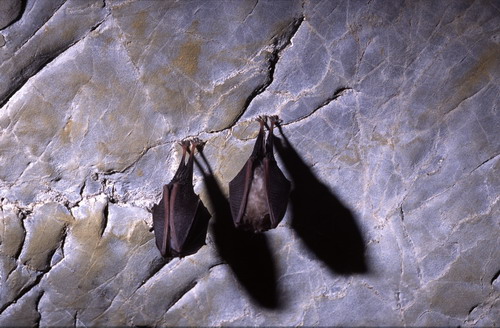
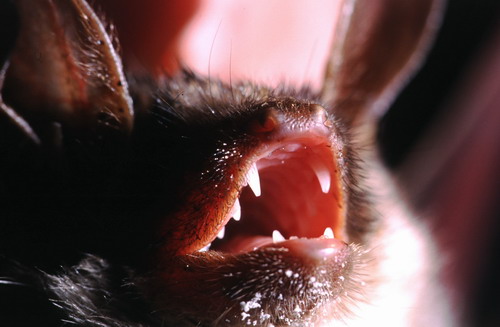
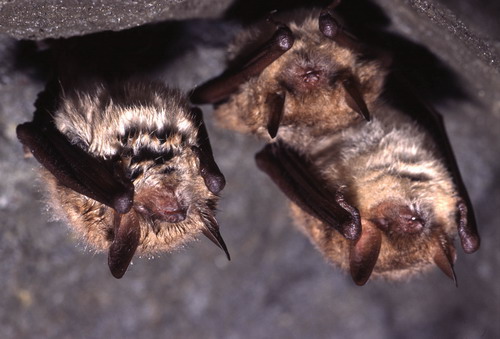
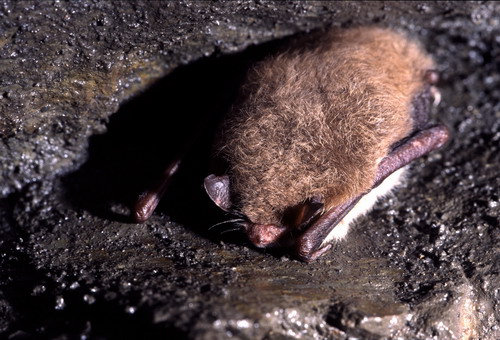
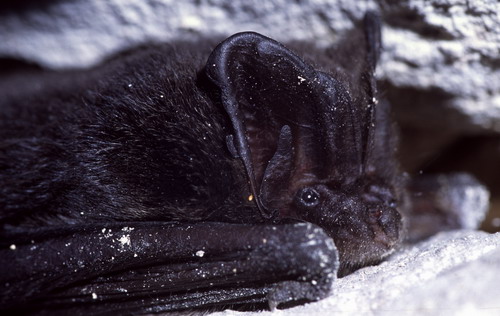
Counts from the 1950s show that the Katerloch used to be far more important as a winter roost: an estimated 300 – 500 lesser mouse-eared bats (Myotis blythi) were found at the time. Today this species is threatened with extinction.
Much of what we know about the bats of the Katerloch comes from studies carried out by Dr Kurt Bauer in the 1950s (BAUER 1987). Bauer observed and collected evidence of 15 bat species, including the first record of the pond bat for Austria (Holocene bone finds).
The following species have been recorded (including records since 2003):
|
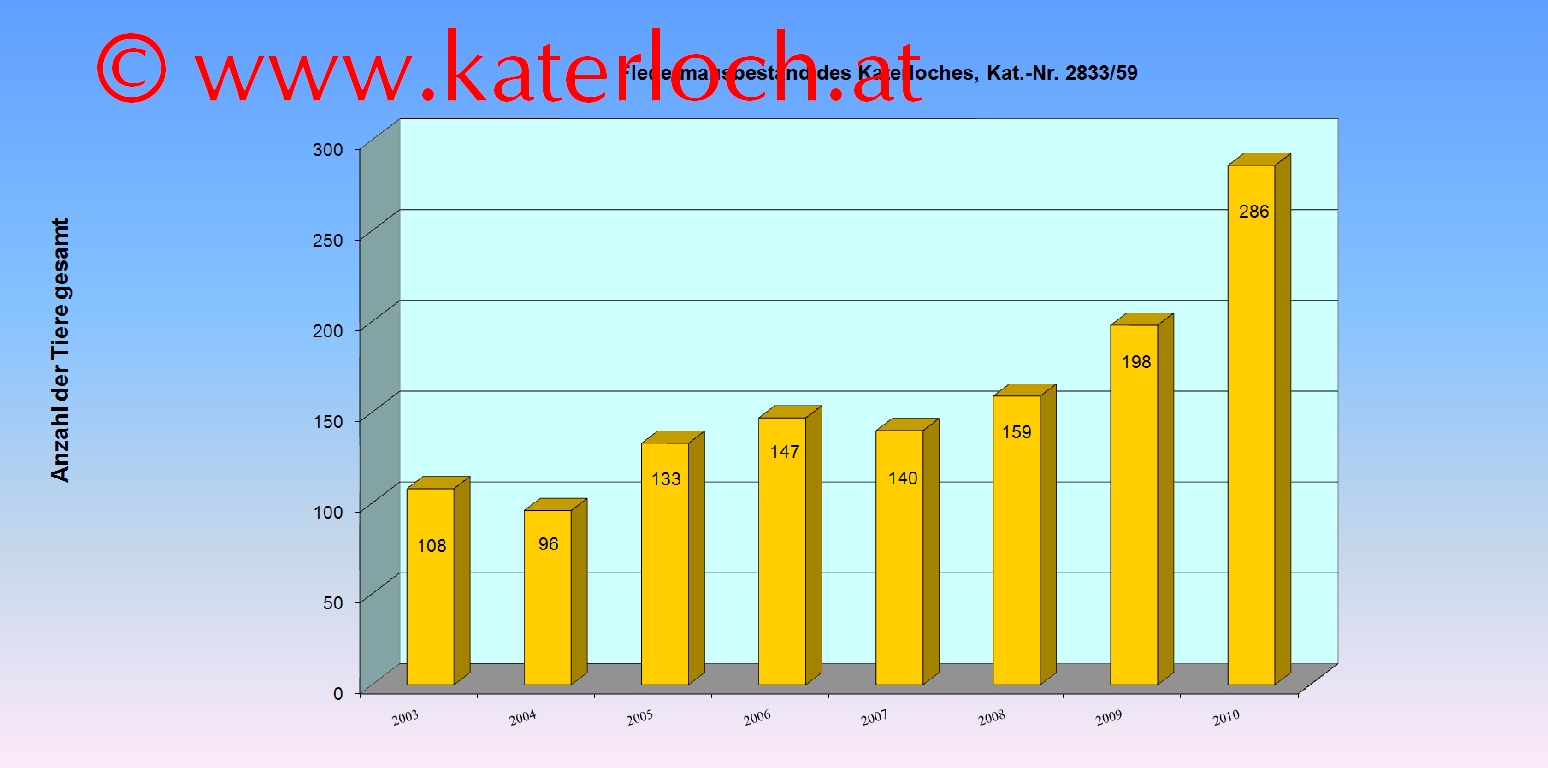
So as not to disturb the bats during their winter rest, guided tours of the Katerloch only take place from April to October.
REFERENCES (in German):
BAUER, Kurt (1987) - Die holozäne Fledermausfauna des Katerloches bei Weiz, Steiermark (Mamm., Chiroptera). Mitt. Abt. Zool. Landesmus. Joanneum, Heft 40, Seiten 25-40, Graz 1987
STROUHAL, Hans & VORNATSCHER, Josef (1975) - Katalog der rezenten Höhlentiere Österreichs, Wiss. Beih. Zur Zeitschrift „Die Höhle“, 24, Seite 518, 519, Wien, Dez. 1975
How the Katerloch got its name:
the “Eulenkater”, or tawny owl (Strix aluco)
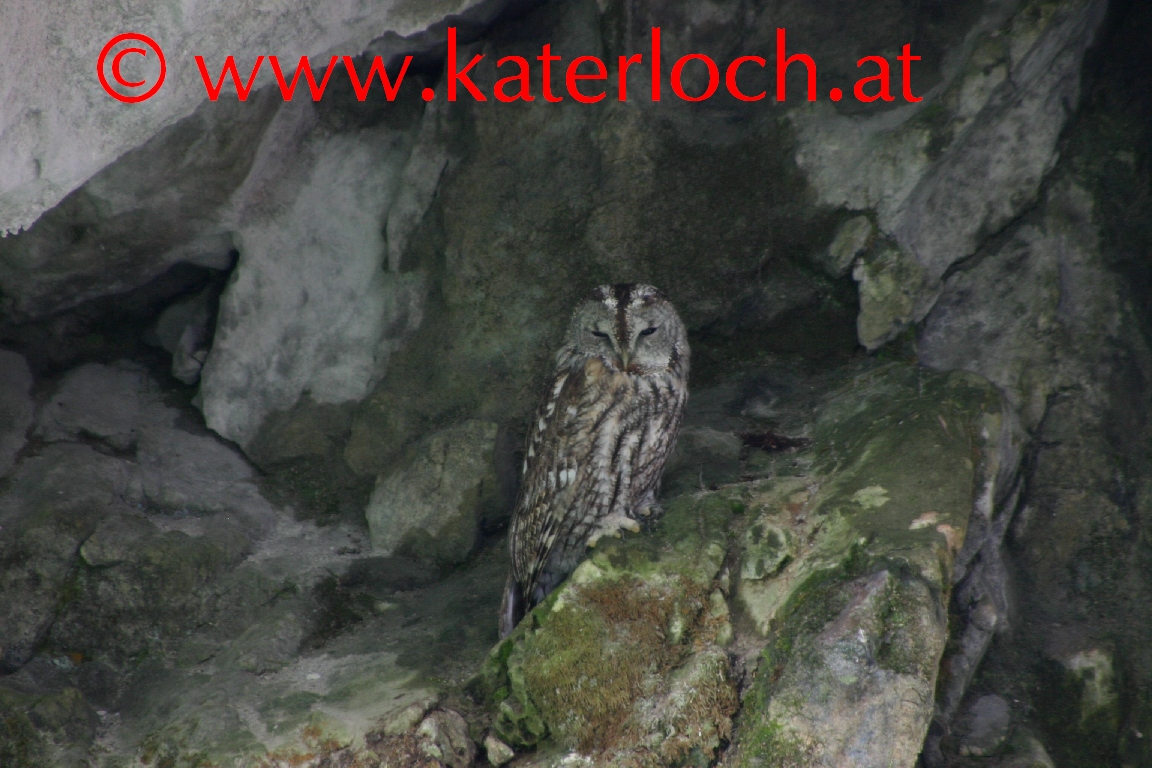
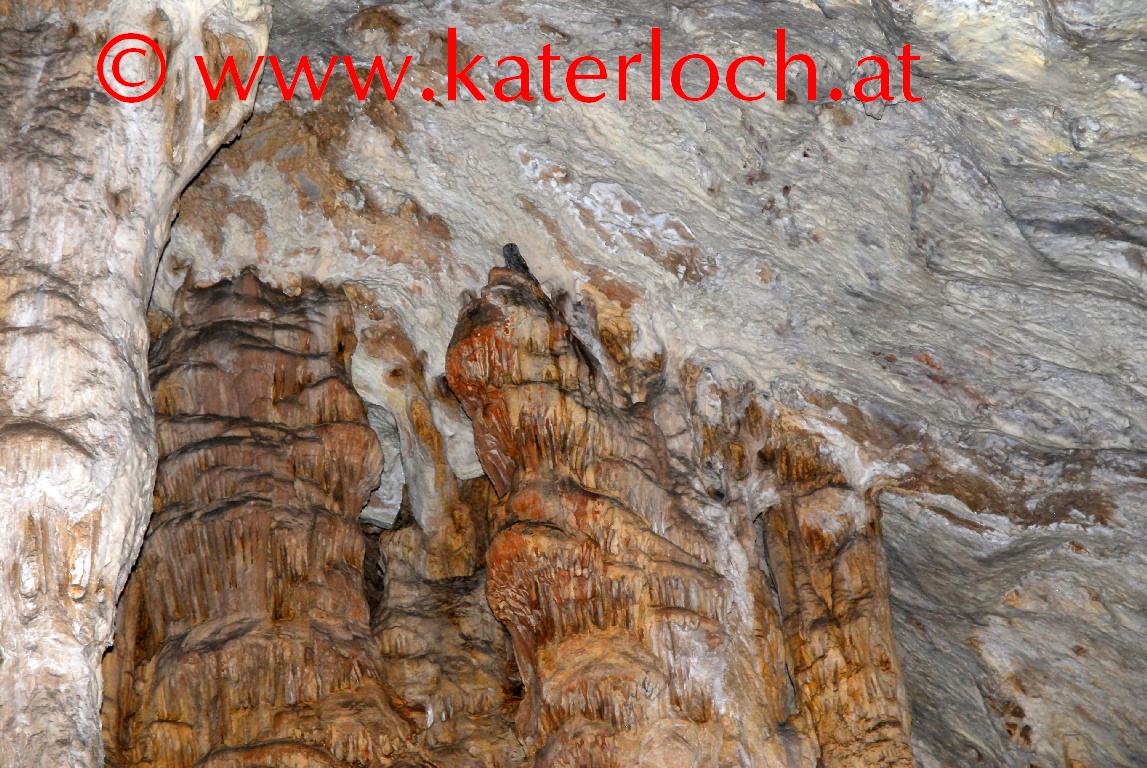
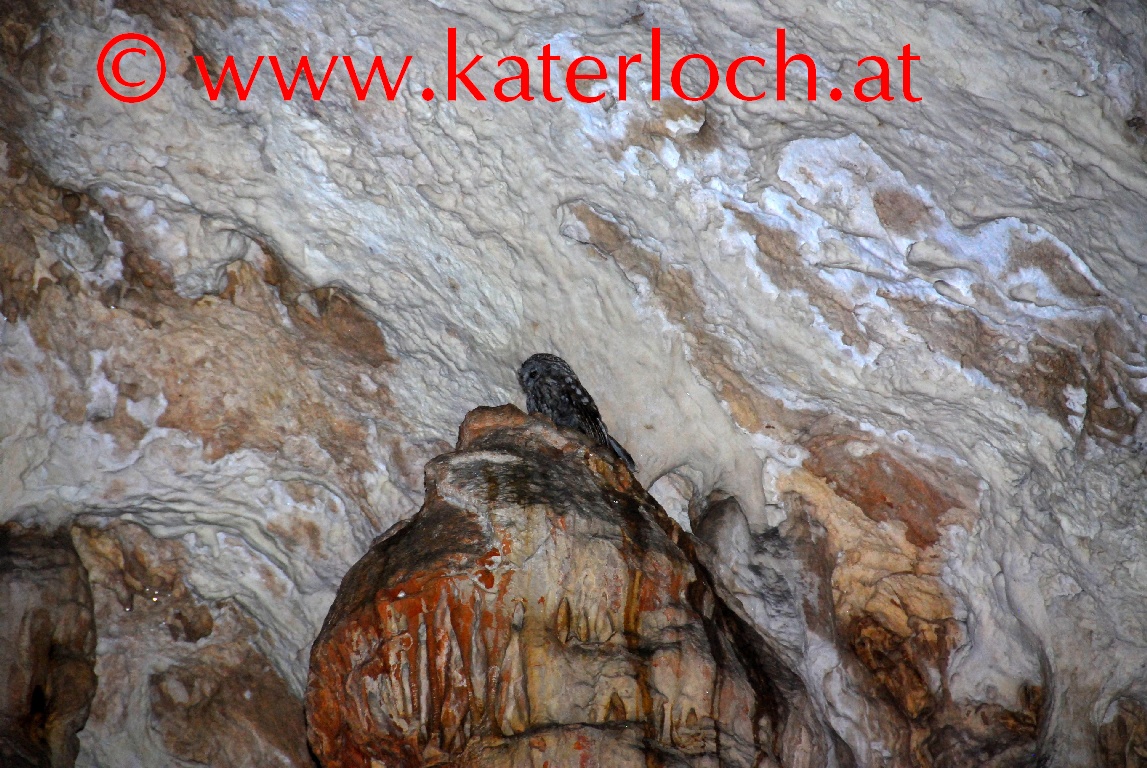
The bird that gave the Katerloch its name belongs to the owl family (subfamily of eared owls and typical owls). Local people watched the so-called “Eulenkater” – the local word for a male owl (“Kater” means tomcat) – fly into the hole in the mountain. The name “Katerloch” (“tomcat hole”) was the logical result.
Distribution
The tawny owl is the most common owl in Europe and is found almost everywhere on the continent except Iceland, Ireland and northern Scandinavia. Beyond Europe its range extends as far as China and Korea.
The tawny owl prefers open deciduous and mixed woodland in a varied landscape. But parkland, cemeteries and gardens with old trees also offer it a suitable habitat, so it can be found in villages and towns as well.
Appearance
The tawny owl is about 40 cm tall and weighs only 450-550g. Its wingspan is almost one metre. Its plumage is either chestnut brown or greyish. Both variants are irregularly mottled, which gives the tawny owl very good camouflage. Males and females cannot be told apart by their appearance.
Senses
The tawny owl's eyesight is very good both at night and by day. Like those of all owls, its eyes are fixed facing forwards. As a result its field of view, i.e. the area it can see without moving its head or eyes, is relatively small. This is made up for by its mobile head, which can turn through 270 degrees . So the tawny owl can look over its right shoulder by turning its head to the left.
For owls, which hunt at night, hearing is the most important sense. They can perceive not only the direction but also the distance of the faintest sounds.
Behaviour
Tawny owls are mainly nocturnal birds. They start hunting twenty minutes after sunset, and on average their activity ends 40 minutes before sunrise. Only while raising their young do they become active before sunset. They live in monogamous pairs in territories divided into a hunting ground and a breeding territory. The difference is that tawny owls are not as aggressive in their hunting ground as in their breeding territory. There they tolerate neither other tawny owls nor other species such as the long-eared owl or birds of prey.
By day the tawny owl rests in dense treetops, while in winter it seeks out caves or niches. Thanks to its good camouflage it can stay sitting quietly even when it has been spotted. You are most likely to notice a tawny owl because of the scolding of small birds that have discovered it. Occasionally tawny owls also sit in direct sunlight to warm themselves. In the Katerloch the “Eulenkater” has particular favourite spots that it likes to use during the day.
At dusk and during the night the tawny owl goes in search of food. Usually it sits on a perch (hunting from a perch) and waits for the sounds of its prey, or it hunts in silent stalking flight. Its diet consists mainly of mice (and bats) and small birds. But larger animals such as brown rats, squirrels or pigeons are also on the menu. In years rich in insects it also eats moths and the like.
Indigestible remains such as bones, hair and feathers are compressed in the stomach into roundish, felty balls and coughed up again. These are known as pellets.
In superstitious times past, its call “kuwitt, kuwitt” was interpreted as the German “komm mit” (“come with me”). An owl's nest nearby was supposed to bring death, which led to the mass killing of owls of every kind.
Breeding
The tawny owl's courtship begins in February/March. At this time the males react particularly aggressively to other males, and fights may break out.
Once two partners have found each other, they stay together for life. Only in the period between the end of rearing the young and the next courtship do they go their separate ways.
The female lays 3-5 eggs on average and leaves them only occasionally until the young hatch after 28 days. During this time the male helps to feed her. Once the young have hatched, the female looks after them while the male provides food for the family. Only after 15-20 days, when the young no longer need to be brooded (kept warm), does the mother help the father to find food. The young hatch blind and only open their eyes after ten days. After about four weeks the young leave the nest for the first time. They are then known as "branchers". They cannot fly yet, as they only get their flight feathers after seven weeks. At three months the young are completely independent of their parents and have to leave their territory.